

AI cyberattacks are on the rise. As if keeping up with all the cybersecurity threats wasn’t bad enough, we now have AI thrown into the mix to make things even more complicated. There has always been one thing that has always been a component in cyber attacks; and that is time.
Before attackers can breach an organization, they usually need a reasonable amount of time to study the target, spot weaknesses, write convincing lures, build or tweak malicious tools, harvest credentials, and work their way through compromised systems.
However, artificial intelligence is starting to shrink that timeline considerably.
To be clear, AI cyberattacks aren’t necessarily a brand-new type of cybercrime. What I’m talking about here is the ability of AI to take the attacks organizations already deal with and make them quicker, cheaper, more scalable, and more automated.
For executives and business leaders, that’s a different kind of problem to solve.
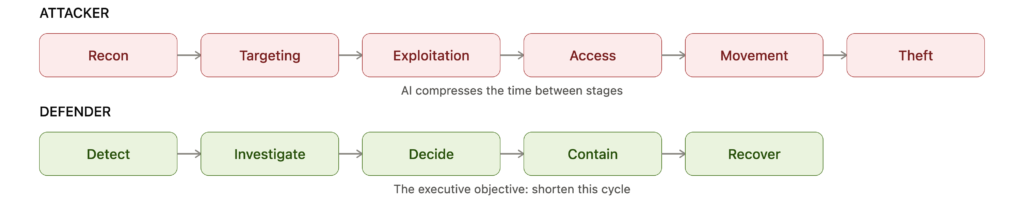
What this means for executives: your security doesn’t need to block every single attempt. What it increasingly needs is to notice, decide, and act faster than the threat.
Jump To:
Toggle
TL;DR: What Executives Need to Know
- AI is speeding up parts of the attack lifecycle, from reconnaissance and phishing to finding vulnerabilities and building malware.
- Attackers don’t need a fully autonomous AI to gain an edge. Making a skilled human attacker significantly more productive is more than enough.
- Google has documented AI-enabled operations that sharply cut the amount of time humans needed to stay involved.
- Basic cybersecurity fundamentals still hold up, however AI mostly helps attackers exploit the same old gaps, but just faster.
- Executives should focus not only on prevention, but on how quickly the organization can detect, contain, and recover.
AI Cyberattacks Are Changing the Time Equation
A lot of the AI-and-cybersecurity conversation is somewhat fixated on what attackers might eventually be capable of. But focusing too much on that can obscure something that’s happening today, and that is AI is helping cybercriminals work more efficiently. Basically it’s making their jobs much easier to execute.
And this was highlighted in Microsoft’s 2025 Digital Defense Report which describes AI as pushing cyber threats toward new levels of speed, scale, and sophistication. It notes that cybercriminals are already using it to scale phishing campaigns and automate pieces of intrusion activity.
More recently, Google’s Threat Intelligence Group reported a shift away from simple AI prompting toward more automated, agentic workflows. According to Google, this kind of automation can substantially cut human-in-the-loop delays, making it much more difficult to defend and respond to an attack.
That distinction is the important one. The question isn’t really can criminals use AI to attack companies? Obviously they can, and they have.
But the real question is: what happens when cybercriminals can perform complex attacks in a few hours, what used to take a team of people days or weeks to do?
In this post, you’ll learn:
- how AI is reshaping the speed and economics of cyberattacks
- where attackers are gaining the most ground
- why AI doesn’t make traditional cybersecurity obsolete
- why response speed is becoming an executive-level concern
- what leaders should be asking their security teams right now
AI Isn't Reinventing Cybercrime, It's Accelerating It
It’s tempting to picture AI cyberattacks as something entirely new. Who knows, in the future we may see autonomous systems hitting companies with no human involved at all. But today the reality is less dramatic and, in a way, more useful to understand.
Most of the weaknesses attackers still exploit are the same familiar ones:
- stolen credentials
- weak passwords
- unpatched vulnerabilities
- phishing
- social engineering
- excessive privileges
- exposed internet-facing systems
- poor security configurations
In April 2026, the UK’s Department for Science, Innovation and Technology warned business leaders that newer AI models are becoming more capable of performing tasks that once required scarce technical expertise. This includes finding software vulnerabilities and helping write malware. The warning also noted the speed and scale by which these tasks are now being performed.
Similarly the UK’s National Cyber Security Centre has made a similar point, stating that AI can make finding and exploiting weaknesses easier, faster, and cheaper.
Now, think of a criminal operation that once needed ten people to research targets, draft phishing messages, dig through technical details, modify malicious code, and sift through stolen data. AI can now dramatically speed up all of these things, giving the attackers a real advantage.
Observe, no new attacks have been used, its the same bad tactics, but the efficiency by which it is now done has been dialed to eleven. Organizations should brace for more experimentation, more targeting, and more attacks at scale.
TSE Perspective: The biggest shift AI is bringing to cybersecurity may not be smarter attacks. It may just be faster.
Where AI Is Making Cyberattacks Faster
This isn’t confined to one stage of an attack. AI is showing up across several points in the attack lifecycle.
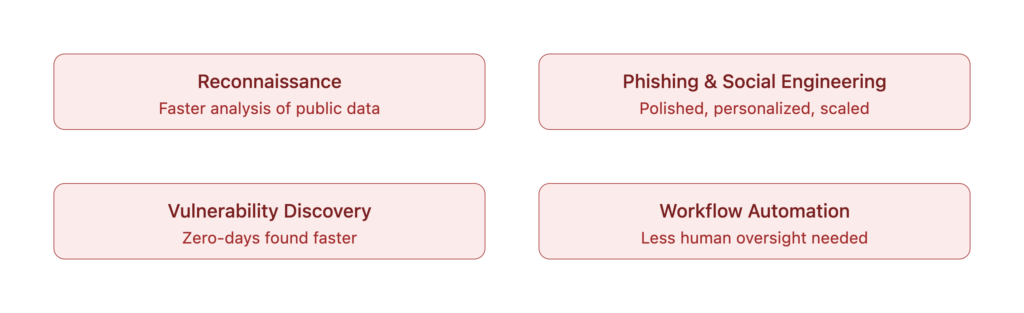
1. Reconnaissance Is Speeding Up
AI can now chew through and summarize large volumes of information far faster a human could. It can research a company’s people, suppliers, email structure, and any known weak points at phenomenal speed.
For executives and high-net-worth individuals in particular, this presents are particular danger, mainly due to the sheer amount of public information about them that’s already out there. Corporate bios, conference talks, social media, press releases, property records, leaked databases, professional networking profiles can now be analyzed far more efficiently by a machine than it ever could by a person.
So an attacker doesn’t necessarily need to dig up more information about you. The AI just makes the information that’s already sitting out there more usable.
Executive takeaway: cutting down unnecessary digital exposure matters more once machines can pick through public data at scale.
Related TSE reading: Your Data Is Being Exposed Faster Than You Think, and our broader coverage of digital risk and online exposure.
2. Phishing and Social Engineering Are Scaling Up
Microsoft’s incident-response data found that phishing and social engineering remain a leading initial-access route, involved in 28% of the breaches it examined.
AI can take an already effective tactic and make it easier to tailor and scale. In the past, clumsy or awkward sounding grammar was a pretty reliable way to identify a possible phishing email. However, generative AI has made it much more difficult to spot these mistakes
Attackers can now produce polished messages, rework them for different audiences, adjust the tone, translate on the fly, and personalize outreach much faster than before.
The concern isn’t just a better-written fake email, either. Picture an attacker going after a senior executive. Public information alone might reveal who reports to them, upcoming travel or conference appearances, the company’s key suppliers, current deals or acquisitions, the names of lawyers and advisers, typical communication style, and recent corporate news.
AI can help stitch those details into far more convincing social-engineering material. Also, synthetic voice and video add another layer of impersonation to create very convincing deep fake videos.
Executive takeaway: employees can no longer rely on awkward phrasing as a warning sign. Verification procedures now matter more than whether a message “looks” legitimate.
3. Vulnerability Discovery Is Accelerating
In May 2026, a report by Google indicated the first known case of hackers using an AI-built zero-day exploit. A zero-day attack is basically a security flaw nobody has patched yet, in a real attack. It’s a sign AI is now helping attackers build hacking tools much faster then before, not just write phishing emails.
Also, the UK’s NCSC has also warned that as frontier AI (the most advanced AI models) gets better at finding vulnerabilities, organizations that haven’t kept up with basic cybersecurity practices are finding themselves very much exposed.
Now this doesn’t necessarily mean that AI can crack open any software, what it does mean is that AI is much better at finding a vulnerability and analyzing code. Therefore the speed by which an attack takes place is considerably faster, as the time gap between an existing flaw and someone exploiting it gets much smaller.
For any organization that takes weeks or months to patch critical systems, that should be a serious wake-up call.
Executive takeaway: patch management has stopped being routine IT upkeep. How long known weaknesses stay exposed is now part of the organization’s overall risk profile.
4. More of the Attack Workflow Is Being Automated
This right here is the most interesting shift.
In September 2026, Google reported seeing hackers move beyond just using AI for one-off tasks like asking it to write a phishing email, but into building automated workflows where the AI can now handle multiple stages of an attack on its own.
In one case from the second quarter of 2026, attackers compromised a cloud resource and then planned, built, and ran an AI-enabled mass credential-harvesting campaign in under six hours, an unbelievably short time for something this complex. Google specifically noted that workflows like this cut down human-in-the-loop latency and squeeze reduced the time to respond.
That’s the trend worth watching closely. It doesn’t need some autonomous AI, like The Terminator’s Skynet, independently deciding to launch attacks on its own. Humans can stay firmly in charge while machines handle all the repetitive time consuming work. Think of the attacker less as being replaced, and more as being amplified.
A Word of Caution on the AI Cyberattack Hype
Now I want to be clear, AI hasn’t suddenly turned every low-level cybercriminal into an elite hacker overnight. Plenty of attacks still lean on familiar vulnerabilities, stolen credentials, sloppy security practices, and human decision-making.
That matters because organizations can just as easily swing to the opposite direction, incorrectly assuming AI cyberattacks have gotten so advanced that existing defenses are pointless. I assure you, they aren’t.
In fact, government cybersecurity authorities keep circling back to many of the same fundamentals organizations should already have in place. The UK’s 2026 warning to business leaders specifically called out strong cybersecurity governance, patching discipline, good credential hygiene, backups, incident preparedness, and established security frameworks. These practices are non-negotiable.
The technology is changing, but many of the weaknesses it exploits haven’t changed. That’s actually good news, because it means that organizations don’t need to fundamentally change their existing cybersecurity programs and start over. They may just need to adjust them, more specifically, to run those programs considerably better, and considerably faster.
The Bigger Problem: Can Your Defenses Keep Up?
This is where I think the executive conversation needs to shift.
Ask most CEOs whether their company has sufficient cybersecurity protection, and the answer will almost certainly be yes. The organization likely has endpoint protection, firewalls, email filtering, multi-factor authentication, security monitoring, vulnerability management, backups, an incident-response plan, and so on.
All of that is important, and there is no disputing that. But the real question is: how quickly can your organization act once something goes wrong? This is the most important question, indeed it has always been the most important question, more so today with AI.
So consider this, say your monitoring flags suspicious activity at 9:00 a.m. Who gets the alert? Who investigates it? Who has the authority to disable an account? Does that require sign-off from someone else? Does it need to be escalated, or pulled into another department? And what happens if the same activity is flagged at 2:00 a.m. instead?
As you can see, this all takes time, or should it? Technology can spot a problem almost instantly while the organization’s own decision-making process crawls along behind it. That gap becomes more dangerous the more attackers automate their side of the equation.
Microsoft notes that defenders are already using AI to shrink some response processes from hours down to minutes, including automated systems that can take action, like suspending a compromised account, once enough high-risk signals line up.
There’s a principle worth taking from this: if AI makes attackers faster, does this mean acquiring another security tool, perhaps an AI tool, automatically makes your organization’s response faster? Not necessarily. Process matters. Authority matters. Preparation matters. Establishing and maintaining cybersecurity fundamentals matters. And also the decisions executives make ahead of time matters.
More Security Tools Aren't Automatically the Answer
When presented with cyber threats that use AI, an instinctive response may be to acquire an AI-powered security. And in some cases that may be the right call. AI can certainly give companies a real advantage, helping security teams sift enormous volumes of data, spot anomalies, prioritize alerts, look for vulnerabilities, and automate parts of incident response.
Indeed, Microsoft says AI is already being used defensively to reduce the response times and operate at a scale human teams couldn’t realistically match on their own.
But, there must be a distinction between acquiring more tools and maintaining the fundamentals. Technology shouldn’t become a substitute for poor cybersecurity practices.
A company running sophisticated AI security tools can still have excessive admin privileges, poor patch management, weak authentication, untested backups, unclear incident-response responsibilities, employees who skip verification steps, and executives who rarely think about cyber risk at all.
AI can’t fix poor governance by itself.
The NCSC’s guidance to leaders in 2026 put it well: “success won’t come from simply owning the most tools. It requires strong fundamentals, fast action, and cybersecurity built into business strategy itself.”
That’s the right frame. AI should make a mature cybersecurity program faster and more capable, it shouldn’t be expected to paper over an immature one.

Five Questions Executives Should Ask Their Security Team
You don’t need to ask your CISO how many AI security products the company has bought. Start with the basics.
- If an important account were compromised right now, how quickly would we know? The answer that’s given will say a lot about your monitoring and detection maturity.
- Once we know, how fast could we contain it? Detection without fast containment just gives an attacker room to keep moving and do more damage.
- Which security decisions still require manual escalation? Look for bottlenecks that don’t need to exist.
- What could one compromised identity actually reach? This tells you whether privilege limits and segmentation are keeping the blast radius small.
- When did we last test this under realistic conditions? An incident-response document sitting in a drawer proves very little. A live simulation proves a lot more. Penetration testing can also reveal weaknesses.
These questions shift the executive conversation away from “are we protected?” and toward “how fast can we recognize, contain, and recover from an attack?” This is a far more useful measure in an environment where attackers themselves are speeding up.
Want the full strategy? Download The Secured Executive’s Executive Privacy Blueprint for practical steps to reduce your digital exposure and strengthen your personal security posture.
Conclusion: AI Cyberattacks Call for Faster Defenses, Not Panic
AI is quickly becoming ubiquitous, there are many positives to it, but there are negatives as well. And as we’ve seen, one negative is how it’s changing how cyberattacks unfold.
With this in mind, executives should resist treating every new development as proof of a completely unprecedented threat. Most of the underlying attack methods are still familiar. What’s changing is the speed, scale, cost, and amount of human effort it takes to pull them off.
That means the organizations best positioned against AI cyberattacks probably won’t be the ones buying the most AI security products. They’ll be the ones that detect sooner, decide faster, contain quickly, and recover well.
The real AI cybersecurity race may be simpler than it sounds: attackers are getting faster. The question is whether your organization is too.
Quick Recap
- AI is accelerating existing cyberattack techniques rather than inventing an entirely new category of cybercrime.
- Reconnaissance, social engineering, vulnerability research, and workflow automation are the areas to watch closest.
- AI doesn’t erase the need for cybersecurity fundamentals, but it makes weak fundamentals more costly.
- Executives should track response speed, not just count up their security tools.
- Identity protection, limited privileges, fast patching, rehearsed response, and quick containment remain essential.
- Defensive AI helps, but it can’t substitute for solid security governance.
Frequently Asked Questions About AI Cyberattacks
What are AI cyberattacks? AI cyberattacks are cyber operations where attackers use artificial intelligence to help with reconnaissance, social engineering, vulnerability research, coding, data analysis, or automation. The term doesn’t necessarily mean the attack runs entirely on its own, in most cases AI is improving a human attacker’s speed and scale.
Are hackers actually using AI right now? Yes. Security researchers at Google and Microsoft have both documented cybercriminals weaving AI into their operations, though the degree varies a lot. Plenty of attacks still rely heavily on humans and conventional techniques.
Will AI eventually replace human hackers? It’s difficult to say. The speed at which the technology is evolving certainly doesn’t discount that possibility. However, for the moment, the more pressing concern is amplification, not replacement. If one skilled attacker can research more targets, generate material faster, analyze vulnerabilities more efficiently, and automate the repetitive parts of the job, cybercriminal productivity rises without a single human leaving the picture.
Can traditional cybersecurity still stop AI cyberattacks? Yes. Strong authentication, patching, limited privileges, monitoring, secure backups, employee verification steps, and incident preparation all remain important. In fact, the NCSC has specifically warned that AI may expose organizations that never got the fundamentals right in the first place.
Should companies go out and buy AI cybersecurity tools? Maybe, but that shouldn’t be the first move. AI can genuinely help companies analyze threats and automate response, but organizations should first figure out where their existing defenses are weak or lacking. A cutting-edge AI security platform won’t fix weak identity controls, excessive privileges, outdated systems, or fuzzy incident responsibilities.
What should executives actually do about AI cyberattacks? Start by asking how fast your organization can detect, contain, and recover. Review identity security, patching cadence, privilege levels, backups, incident-response authority, and verification procedures. They should also revisit those assumptions regularly, since both AI capability and attacker technique keep advancing.