Generally, most of the artificial intelligence we use today, like large language models such as ChatGPT and Claude, revolve around it waiting for us to tell it what to do. We input the information, usually a typed prompt, and then the AI outputs an answer. With this answer, we then evaluate it to make a decision as to what the next step should be. So basically, the AI responds to the information we input into it.
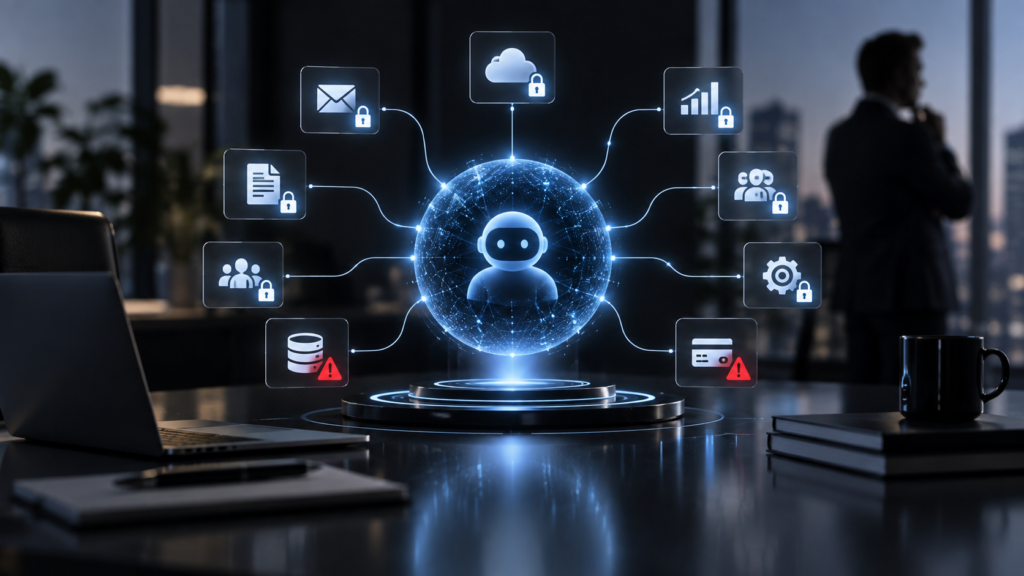
However, with the rise of so called AI agents that are now beginning to change that relationship. Instead of simply producing information, this type of AI system can be connected to business systems, access data, use software tools, complete multi-step tasks, and in some cases take action without waiting for a person to approve every step. A significant change to say the least.
Although this change certainly creates enormous potential, it also raises a new security question: what happens when AI is given the authority to act inside your organization? That’s where AI agent security becomes an executive issue, not just a technical one.
AI agent security is the set of controls and protocols that must be implemented to protect AI agents, the systems they interact with, and the information and actions placed within their reach. Basically, that means understanding who or what the agent is, which systems it can access, what information does it have privy to, which tools it can use, what actions it can perform, how its access is authenticated, how much autonomy it has, whether its activity can be reconstructed afterward, and who is ultimately responsible for it.
These are much more than just theoretical concerns. NISTis already examining how existing identity and authorization standards can apply to software and AI agents — identification, authorization, auditing, and accountability. The reason is straightforward: an AI system that merely offers advice creates one kind of risk, and an AI system that can act on that advice creates another.
From Answering to Acting
Ask a conventional AI tool which of a batch of invoices looks suspicious. It will analyze the data and output the answer. At the end, a person still decides what happens next.
Now tell an AI agent to investigate suspicious invoices and take the appropriate action. Depending on the permissions you’ve given it, that agent could examine transactions, access records, contact employees, flag accounts, create reports, or trigger a workflow all on its own. The AI has moved from providing information to exercising authority, and that distinction changes the security conversation entirely.
The Secured Executive Perspective: The most important question about an AI agent isn’t how intelligent it is. It’s how much authority it has.
Here is a business example. Suppose a customer emails a company saying:
“I was charged twice for my order. Can you fix this?” A conventional AI like ChatGPT or an automated response chatbot might read an email and draft an appropriate response for an employee. The response can be a generic response indicating that the issue may be escalated for further inquiry.
An AI agent on the other hand, if it’s been given the necessary access to data and permissions, could potentially read the email, identify the customer, log into the company’s order system, check the transaction history, determine that there was a duplicate charge, initiate a refund, update the customer record, and send the customer a confirmation email.
This is a significant difference. The AI agent has now moved beyond “Here is what I recommend” to “I have done it.”Here is another example:
Conventional AI: “This customer appears to have been charged twice. I recommend issuing a refund.”
AI agent: “I verified the duplicate charge, issued the refund, updated the customer record, and emailed the customer.”
The AI agent has now taken control of the situation and provided the appropriate solution to the issue.
Why AI Agents Create Different Security Risks
AI agents haven’t made traditional cybersecurity principles obsolete. Principles like authentication, access control, and monitoring are still extremely important, even more so. OWASP identifies a range of AI-agent risks, including prompt injection, tool abuse, privilege escalation, data exfiltration, memory poisoning, excessive autonomy, and high-impact actions taken without adequate oversight.
Therefore, we as humans must understand the risk. If we allow an AI agent access to sensitive information, we must be prepared to deal with the potential consequences of that decision. Because the AI agent will now make decisions based on the particular situation and provide a resolution with the information that it now has access to. The risk is if the AI agent makes the right decision when attempting to resolve an issue.
For executives, risks get easier to manage once you break them into four questions: What can the agent reach? What information can it expose? What can it actually do? and who is accountable when something goes wrong?
What can the agent reach?
An agent may need access to email, cloud storage, customer records, financial systems, HR information, databases, APIs, or internal documents. The access that is given should never be more than what is needed. An agent built to summarize documents may need permission to read them; that doesn’t mean it should also be able to modify or delete them.
This distinction may seem rather obvious, but granting excessive permissions, when it’s not necessary, has been a major cybersecurity problem for decades, and AI doesn’t make that problem disappear on its own. It’s basically the same problem, but instead of people, the AI has now been granted access to excessive information.
What information can it expose?
An agent may pull information from several systems while completing a single task such as customer data, financial records, employee information, intellectual property, confidential communications, or credentials. The risk isn’t just what the agent can read; it’s also what it does with the information and where the information goes afterwards. An agent that communicates with external tools like APIs, vendors, or even other agents expands the organization’s trust boundary well beyond what most people are even aware of.
What can it actually do?
This is where AI-agent risk becomes especially serious, because reading information and acting on it are entirely different and do not have the same level of authority. An agent that reads an email is not the same as one that can draft an email and send it; reviewing a transaction is not the same as executing it; identifying files is not the same as deleting them. The underlying information may be identical, but the consequences are not.
Who is accountable?
Software cannot become the end of the accountability chain. If an AI agent makes a damaging decision, exposes information, or initiates an unauthorized action, someone inside the organization still owns that outcome and the consequences of it. That makes ownership critical, therefore, every significant AI agent should have a clearly identified business or technology owner responsible for its purpose, permissions, continued use, and risk.
AI Adoption Is Moving Faster Than Governance
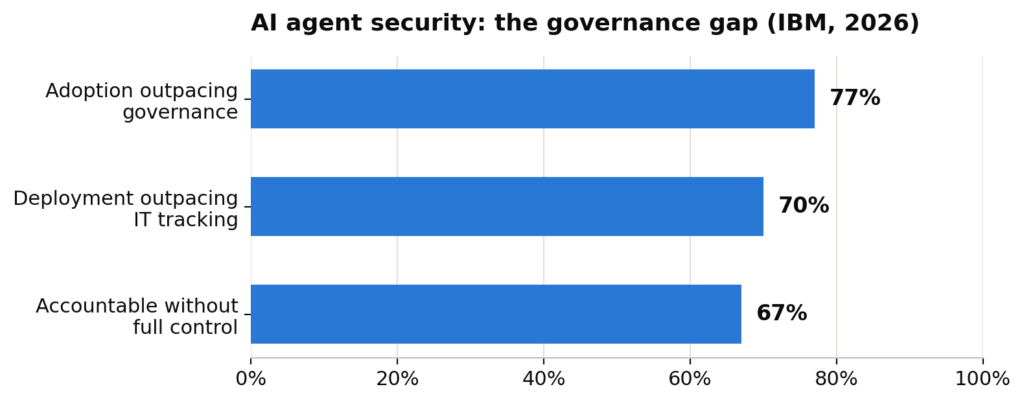
This isn’t a problem executives can leave for some distant future. IBM’s 2026 global studyof 2,000 C-level technology executives found that 77% said AI adoption was already outpacing their organization’s governance capabilities. Seventy percent said technology was being deployed across the business faster than IT could track, and two-thirds of surveyed CIOs and CTOs said they were being held accountable for AI systems that they didn’t fully control.
That’s not simply a cybersecurity problem. It’s a management problem. As I’ve always said, cybersecurity and information security in general is at the heart a management issue, and it only gets more serious as agents move deeper into operational systems.
An AI Agent as a Digital Actor
A useful mental model is to think of an AI agent almost like a digital employee. The analogy isn’t perfect, but it forces organizations to ask the same familiar questions, and take the same precautions as it would as if it were a human that was being given access to privileged information.
When someone joins a company, you would make a point in knowing who they are, what their role is, which systems they need, what information they may access, what they’re permitted to change, which decisions require approval, who supervises them, and when their access should be removed.
There’s no good reason an AI agent should bypass that same scrutiny. If an agent acts on behalf of your organization, it needs an identity, defined permissions, boundaries, monitoring, and an owner, the same way a new hire would.
Least Privilege Still Matters
One thing years of managing IT teaches you is that improper access has consequences. Protocol matters, you don’t give every employee administrator rights because it would make their job more convenient, well at least, you shouldn’t.
Someone in marketing may need customer information but not payroll. Someone in accounting may prepare a transaction without having authority to approve it. Administrators get greater privileges because their jobs require them, and those privileges deserve greater scrutiny precisely because the consequences are greater.
AI shouldn’t cause us to abandon those principles, if anything, the more independently a system can act, the more they matter, and thus should be given greater scrutiny. Instead of asking what you could connect an agent to, ask what the minimum access is that it needs to do its job.
AI Agent Security Is Also About Authority
The AI-security conversation often concentrates on whether a model is accurate, whether it could hallucinate, or whether employees should be using generative AI at all. Those questions still matter, but agentic AI adds another: what authority are we delegating to machines? That question reaches well beyond cybersecurity, into corporate governance, internal controls, and executive accountability, a topic worth its own deep dive
Conclusion: Secure the Authority, Not Just the AI
AI agents have the potential to remove repetitive work, improve productivity, and let organizations automate increasingly complex processes. Businesses should take that opportunity seriously, and take the authority they’re handing over just as seriously.
AI agent security is mainly about controlling what the agent can reach, what it can know, what it can do, and what happens when something goes wrong.
Before connecting an AI agent to an important business system, ask: would you let a new employee touch this system on day one, with no training, no supervisor, and no exit date? If the answer is no, don’t extend that arrangement to an AI agent either.
Quick Recap
AI agents have the ability to access sensitive information and make decisions, not merely to provide information. Their security depends heavily on identity, access, permissions, monitoring, and accountability. Access to information and authority to act are different risk levels, so apply least privilege and stronger safeguards around high-impact actions — and make sure every significant agent has a human owner.
Frequently Asked Questions
What is AI agent security? AI agent security refers to the controls used to protect AI agents and the systems they interact with, including identity, authorization, permissions, data access, tool use, monitoring, testing, and oversight.
How is an AI agent different from a chatbot? A chatbot primarily responds to requests. An AI has been granted access to information and systems such as access to business systems, and armed with enough information and autonomy to make decisions and execute tasks on it own.
Are AI agents dangerous? Not inherently. Their risk depends heavily on what they can access, which tools they can use, and what actions they’re authorized to perform.
What is least privilege for an AI agent? It means giving the agent only the access and capabilities required for its assigned task — nothing more.
Where does the buck stop? And by Whom? The organisation and the one who has granted access to the AI agent is ultimately responsible for its actions and consequences. Significant agents should have an identifiable human or business owner responsible for their purpose, permissions, oversight, and continued use.