

Jump To:
Toggle
Information Systems: So much more than just Spreadsheets and Emails.
I remember my first job, as an IT administrator at a major bank, I was always being called to fix something with the computer. The impression people had about me was that I was some kind of glorified TV technician. Indeed, that’s the impression most people had about the entire Information Systems department.
In many people’s minds, the term information systems was nothing more than sending emails, doing spreadsheets, and having the printer ready for daily reports. However, you’ll soon come to understand that information systems are much, much more.
We all know the modern world is continuing its trend of rapidly evolving technological advancements, especially digital transformation. The role of information systems (IS) has become increasingly pivotal for organizations aiming to thrive in this ever-changing and advancing landscape.
Today, information systems are the beating heart of organizations. They drive innovation, define consumer experiences, bring forth new products and services, and propel businesses to new heights where they have never been before. IS has evolved into a strategic cornerstone, affecting every facet of an organization’s performance. This includes the ability to streamline operations and optimize supply chains, as well as the ability to unleash data-driven insights and power ground-breaking innovations.
To streamline operations and provide optimization, information systems contain a wide variety of technologies, processes, and data. They have evolved beyond their traditional purpose of assisting with normal company operations to become important instruments for strategic management and strategic decision-making, and for gaining that all-important competitive edge.
In an ever-changing climate, where data is being hailed as the new currency, organizations are driven to strategically leverage the power of information systems. These systems negotiate complexity, stimulate innovation, and acquire a sustainable edge in a global economy that is becoming increasingly competitive.
In this article, we’ll delve into the role that information systems play in the contemporary corporate world. We’ll explore how they enable organizations to gain a competitive edge, help in making essential company decisions, and set out to achieve long-term progress. So are you ready to unlock the strategic potential of information systems within your organization? Well then, let’s roll!

Strategic Information Systems
The information systems (IS) of modern businesses are seen as crucial to their overall strategy. This is because businesses are extremely dependent on these systems, so much so that if their information systems were to go down even for a moment, it would severely affect the company. These losses can be in the millions, hundreds of millions, or even billions of dollars.
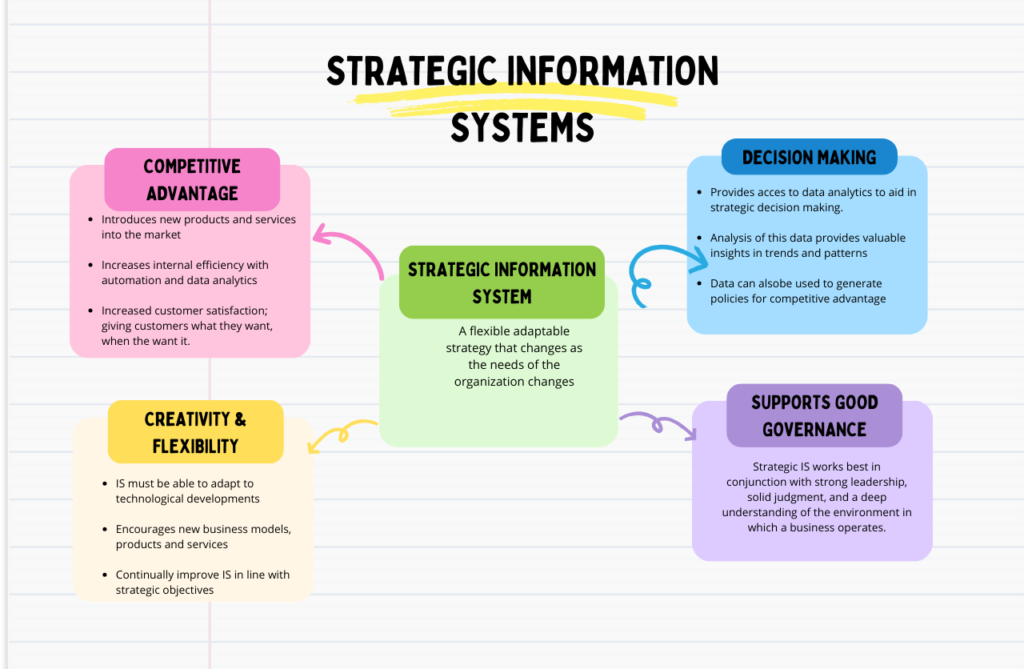
Strategic importance develops as a result of the way the organization competes in a particular sector that it pursues, or the characteristics of the sector it’s in. In other words, the strategic information system for a particular organization should be aligned with the overall business strategy of the company.
The company’s strategic decision-making should be flexible and adaptable, changing accordingly as the needs of the company change. It should also be secure by protecting the company’s data from unauthorized access, and reliable enough to provide accurate information in a timely manner.
IS and Competitive Advantage
Companies started using their information systems strategically to obtain a competitive edge since the late 1980s and early 1990s, and this has increased as interconnectivity has grown exponentially in the last couple of decades. Strategic planning is made easier with the use of information systems that reveal patterns in the market, consumer habits, and internal performance indicators.
Companies may use this data to better adapt their strategy to ever-shifting market conditions. I believe that most of an organization’s IT infrastructure efforts should be toward gaining a competitive advantage. Here are a few ways IS can be used strategically to help an organization achieve a competitive advantage.
Introduce Novelty Products and Services
Information systems may help businesses gain an advantage in the market by easing the creation and distribution of new products and services.
Enhance Internal Operations
Efficient and cost-effective operations may be achieved via the use of automation, data analytics, and collaborative platforms
Increase Customer Satisfaction
Every company wants to have the ability to attract new customers and keep their existing ones. This may be accomplished through the use of data-driven marketing techniques, personalized interactions, and real-time support mechanisms.
It should be noted that in some cases, the competitive advantage gained could be short-lived. This is because competitors can easily replicate IS developments relatively easily. Therefore, to gain that competitive edge and have a more lasting effect, a company needs to have technology in place before its competitors get access to the same technology. This gives rise to the idea of competing in time, where a company has to develop a technology fast and first in a particular field.
Real World Example
Amazon is a prime example of the aspects discussed above. Amazon was an early pioneer in making full use of the Internet’s capabilities when it was launched back in 1994. Even though the Internet was still in its infancy as a technology, Amazon was an early adopter of the platform, using it to establish a dominant market position through the creation of a vast online presence.
Of course, Amazon did not stop there, let’s be honest, you don’t get to be a trillion-dollar company by resting on your laurels. Amazon has been able to maximize technology and use it for data analytics. To provide customers with more relevant suggestions and advertising, the firm stores a massive amount of data about their customers actions. This data may include their search and purchase histories, which helps to boost sales and increase overall customer satisfaction.
The logistics and supply chain processes at Amazon are another area where a technology strategy has played a major role. The company’s fulfillment facilities and delivery routes are optimized with the use of complex algorithms and software technologies.
This has helped Amazon stand apart from its competitors by allowing the firm to provide consumers with speedier and more predictable delivery dates. When it comes to new technologies, Amazon has been miles ahead of the curve, distinguishing itself with innovations such as Amazon Prime, One-Click ordering, fulfillment centers, and logistical developments.
All of this has allowed Amazon to offer unparalleled customer service which has given the company a significant competitive advantage and has allowed it to remain the dominant player in the e-commerce and cloud computing field.
Creativity and Flexibility
The success of any business relies on its ability to adapt to change. Change can occur in the market in which it exists, in consumer preferences, in technology, exposure to competition, and economic climate. The ability to easily share and access relevant information, as well as to collaborate on projects, is one way in which information systems may encourage creativity. In addition to bolstering R&D initiatives, they have the potential to spur organizational transformation.
Flexible and Expandable Infrastructure
Your IS needs to be able to roll with the punches as company demands and technological developments evolve. A well-developed Information Technology strategy is absolutely necessary moving forward to achieve company goals.
Encouraging Projects Focused on Innovation
Information systems can facilitate new business models, data-driven decisions, and experimentation of new products and services.
Continuous Improvement
Updating and reviewing the company’s IS on a regular basis keeps it in line with strategic objectives and market changes.
Summary
I’ll leave you with the following points on the importance of information systems as a strategic tool for an organization.
- Information systems can reduce the likelihood of making choices based on your instincts or your gut feeling.
- Information systems enhance the likelihood of effective strategic decision-making by increasing success rates.
- Information systems can increase the speed at which decisions are made, while also improving their efficiency.
- Information systems can make it possible for enterprises to get a competitive advantage in the market.
Although there are several advantages of using information systems as a strategic tool, it is important to keep in mind that they are just that, tools. They are most effective when utilized in conjunction with strong leadership, solid judgment, and a deep understanding of the environment in which a business operates.
It is equally essential to keep in mind that the exact strategic function of information systems will differ based on the industry, size, and the specific goals of each organization. Nevertheless, companies may employ information systems as a strong instrument to generate sustainable competitive advantage and long-term success.